
Detection Is Good, but Resilient Assessment Ecosystems Matter More
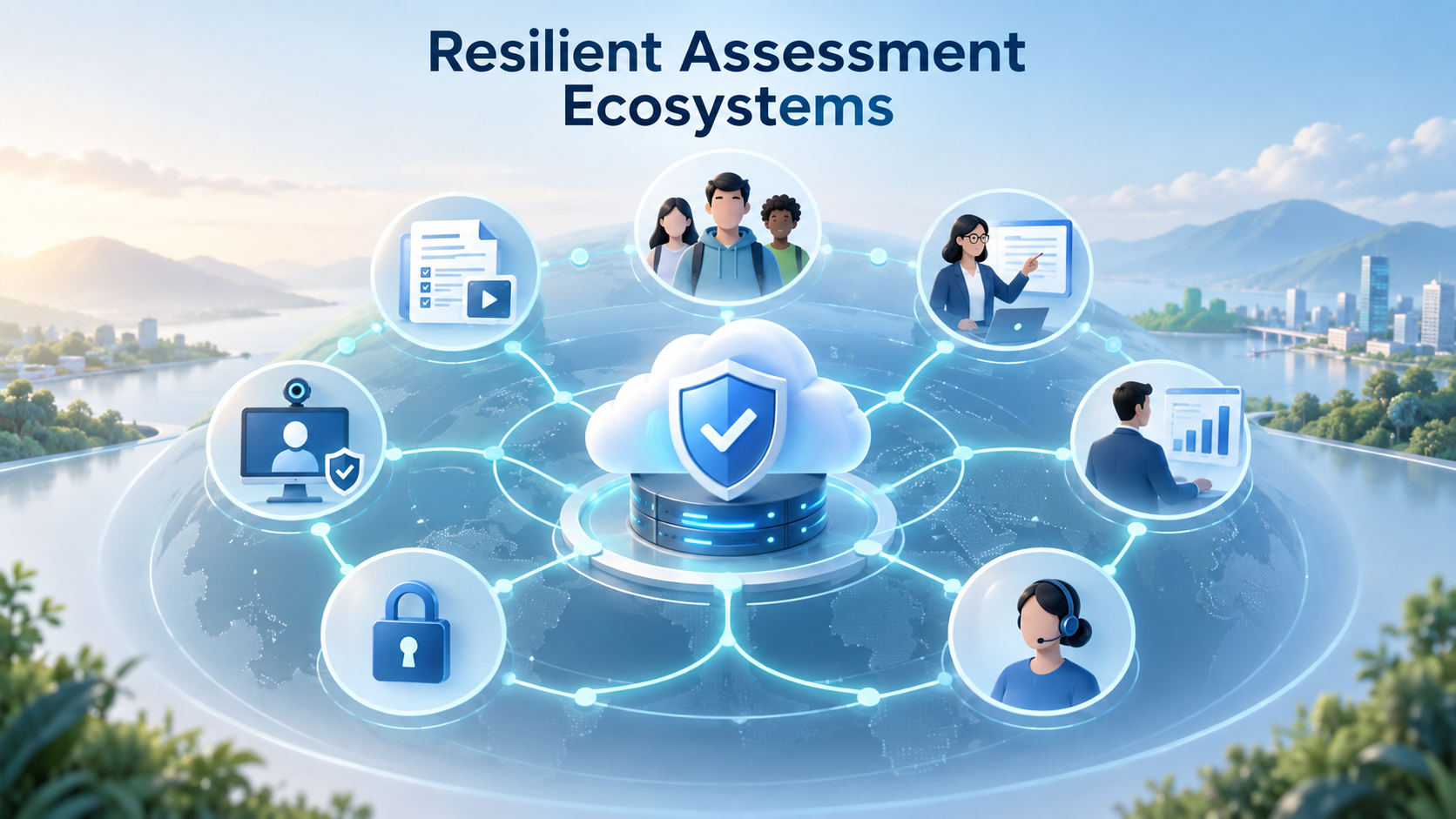


For the past few years, much of the conversation around AI and academic integrity has focused on detection. Organizations have adopted plagiarism checkers, AI-content detection tools, and other technologies to identify AI generated content. These capabilities continue to play an important role. However, as artificial intelligence becomes more capable, relying only on detection may no longer be enough.
Generative AI is becoming increasingly sophisticated in producing content that resembles human writing. It can adapt tone, sentence structure, vocabulary, and writing style. It can also be prompted to introduce small grammatical errors, simplify language, rewrite content several times, or imitate examples of a person’s previous writing. As these capabilities improve, the line between AI-assisted and completely human generated work can become increasingly difficult to determine through detection alone.
This changes the question institutions need to ask. Instead of focusing only on “Was this written by AI or by a human?", the more meaningful question may be: “Does the learner actually understand what they submitted?" This requires moving from a detection-first approach toward a broader Resilient Assessment Ecosystems.
Consider a simple example, a bank employee recommends approving or rejecting a loan application. Instead of checking whether AI helped prepare the recommendation, the manager can ask why certain financial details were considered important, how the risk was assessed, what alternatives were reviewed, and how the final decision was reached. This checks the employee’s understanding, judgement, and problem-solving process.
A student submits a detailed written answer that may have been created with AI assistance. Rather than depending entirely on an AI-detection score, the assessment platform can automatically generate follow-up questions based specifically on that student’s response. The learner may be asked to explain why a particular argument was selected, defend a conclusion, apply the same concept to a new situation, or explain the reasoning behind a specific sentence. These questions can become progressively adaptive based on the learner’s responses.
This approach changes the challenge significantly. Even when AI has helped create the original answer, the learner must demonstrate understanding, reasoning, application, and ownership of the response. Combined with identity verification, secure assessment controls, behavioural signals, plagiarism checks, proctoring, adaptive questioning, and human review, assessment integrity becomes less dependent on any single detection technology.
The future of assessment integrity, therefore, may not be about finding the perfect AI detector. It is about creating multiple layers of defence where different controls work together and where genuine understanding becomes harder to imitate.
At Excelsoft Technologies, we are looking beyond detection and building Resilient Assessment Ecosystems that combine assessment design, adaptive questioning, behavioural signals, technology, and human review. The goal is to ensure learners demonstrate genuine understanding, reasoning, and ownership of their responses.