The Future of AI in Online Proctoring: From Flags to Fairness
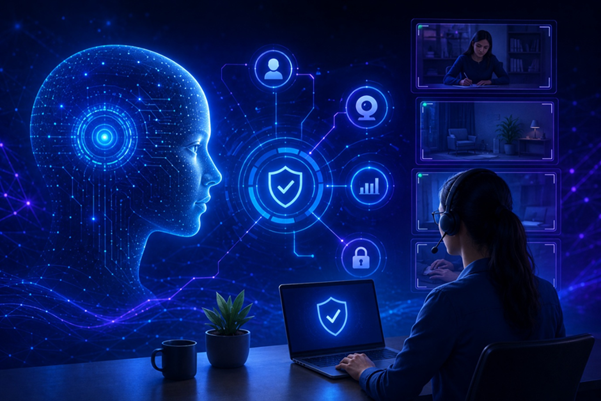


As online assessments become an integral part of education and professional certification, institutions face the dual challenge of maintaining academic integrity while ensuring a fair and seamless experience for learners. AI-powered online proctoring has transformed remote invigilation, but simply detecting suspicious events is no longer sufficient. The future lies in intelligent systems that understand context, reduce false positives, and support human decision-making.
The Early Days of AI-Powered Proctoring
When AI was first introduced into online proctoring, its role was straightforward: detect suspicious activity and alert the proctor. If a student looked away from the screen for an extended period, another face appeared in the webcam, or a prohibited object was detected, the system generated a flag.
These capabilities, powered by computer vision and rule-based AI models, marked a significant advancement over manual monitoring. Institutions could automatically identify potential violations during remote examinations, making online assessments more secure and scalable.
At the time, simply being able to detect such events was considered a major innovation, and organisations rapidly adopted AI-powered proctoring solutions.
Why Detection Alone Isn’t Enough
As online assessments have become more widespread and AI technologies have matured, institutions have realised that detection alone does not guarantee fairness.
A flag does not necessarily indicate misconduct. A student may glance away while recalling information, a family member may briefly walk through the background in a shared home environment, or temporary internet disruptions may interrupt the examination. Similarly, candidates wearing spectacles or adjusting their seating position may unintentionally trigger alerts.
Treating every deviation as suspicious often results in a high number of false positives, increasing the workload for proctors while creating unnecessary stress and anxiety for students.
From Event Detection to Contextual Intelligence
The next generation of online proctoring must move beyond isolated event detection and embrace contextual understanding.
Rather than reacting to individual incidents, AI should analyse behaviour over time, considering the duration, frequency, sequence, and context of multiple events before determining whether an alert is warranted.
For example, instead of flagging every instance of a student looking away from the screen, an intelligent system should evaluate:
- How frequently the behaviour occurs
- How long each instance lasts
- Whether it coincides with other suspicious activities
- Whether the overall behavioural pattern aligns with known indicators of academic misconduct
Likewise, temporary network interruptions, ambient background noise, or brief environmental distractions should not automatically escalate into high-risk alerts. Modern AI should distinguish normal human behaviour from behaviour that genuinely requires further investigation.
This evolution requires the integration of computer vision, behavioural analytics, and machine learning to identify meaningful patterns rather than isolated anomalies.
Benefits for Institutions, Proctors, and Learners
A context-aware approach delivers measurable benefits across the assessment ecosystem.
1. For institutions
- Greater confidence in assessment integrity
- Reduced manual review effort and operational costs
- More consistent and evidence-based decision-making
- Improved scalability for large-volume online examinations
2. For proctors
- Fewer but more meaningful alerts
- Better prioritisation of high-risk cases
- Reduced alert fatigue
- More time to focus on situations requiring professional judgement
3. For learners
- Fairer treatment during examinations
- Reduced anxiety caused by unnecessary flags
- Greater transparency in the assessment process
- Increased trust in remote assessment technologies
Ultimately, AI should enhance the assessment experience for everyone involved—not simply increase the number of alerts generated.
AI Should Support Human Judgement
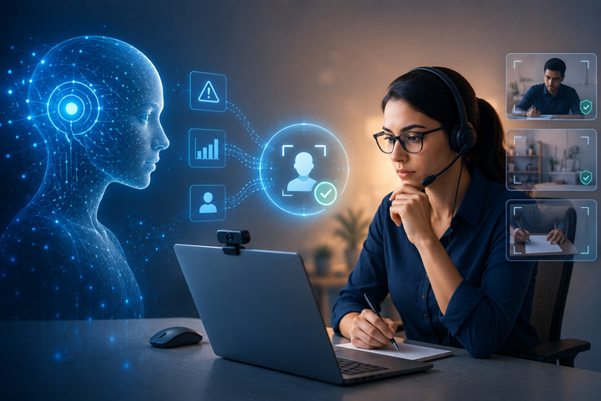
The future of AI in online proctoring is not about becoming stricter, it is about becoming smarter.
Intelligent systems should function as decision-support tools rather than decision-makers. Before raising an alert, AI should seek sufficient evidence by analysing multiple behavioural signals and identifying consistent patterns over time.
This evidence-based approach improves accuracy, significantly reduces false positives, and strengthens confidence in remote assessments.
A useful analogy comes from cricket’s Decision Review System (DRS). Technology provides additional evidence to support the umpire’s decision, but when the available evidence is inconclusive, the original decision stands. Technology assists judgement—it does not replace it.
Online proctoring should follow the same philosophy. AI should provide contextual insights and supporting evidence, while trained proctors make the final decisions based on experience, context, and professional judgement.
The Future is Fair, Transparent, and Intelligent
The success of AI-powered online proctoring will not be measured by how many alerts it generates, but by how accurately it distinguishes genuine risks from everyday human behaviour.
The industry’s focus is shifting from simple detection to intelligent understanding, and from surveillance to fairness.
As AI continues to evolve, institutions should look beyond technologies that merely identify anomalies and instead invest in solutions that provide contextual intelligence, improve operational efficiency, and create trustworthy assessment experiences.
The future of online proctoring is one where AI and human expertise work together to uphold academic integrity while ensuring every learner is treated with fairness, transparency, and trust.
Looking for Smarter Online Proctoring?
Excelsoft’s easyProctor combines AI-powered monitoring with human oversight to deliver secure, scalable, and fair remote assessment experiences. By reducing false positives and providing meaningful, context-driven insights, easyProctor helps institutions protect academic integrity while enhancing the learner experience.
Explore easyProctor to discover how intelligent online proctoring can transform your digital assessment strategy.