
Online Assessment Platform: Enterprise Guide (2026)
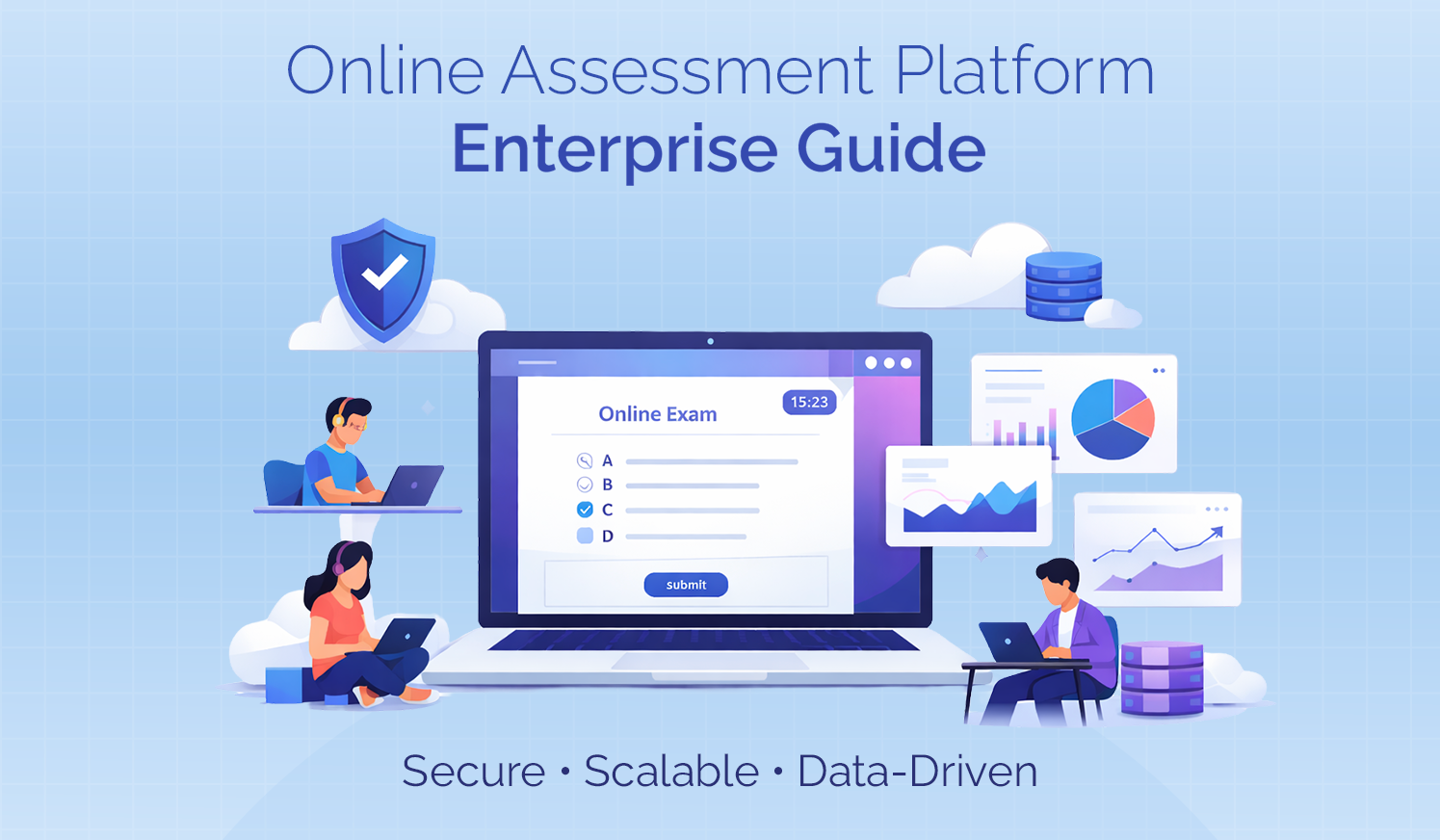


Assessment has become mission-critical for education providers, certification bodies, and enterprises. As learning and hiring increasingly move online, organizations need reliable online assessment software that can deliver secure exams, generate actionable insights, and scale globally.
Today’s leaders are not simply digitizing tests – they are building data-driven evaluation ecosystems. This guide explains what modern solutions should deliver, why adoption is accelerating, and how Excelsoft’s Test & Assessment supports enterprise-grade programs.
Industry Context and Definition
Online evaluation has evolved rapidly alongside the expansion of digital learning ecosystems. According to Wikipedia’s article on electronic assessment, this approach refers to the use of information technology in the assessment process, enabling tests to be delivered, scored, and analyzed through digital systems. This shift has allowed institutions and enterprises to move beyond traditional paper-based exams toward scalable, data-driven evaluation models.
At the same time, global education bodies emphasize that digital infrastructure is becoming foundational to modern learning systems. UNESCO highlights that the rapid growth of online and hybrid learning environments has increased the need for reliable technology-enabled assessment methods that support continuity, accessibility, and quality assurance in education and workforce development.
Together, these developments explain why organizations are investing heavily in secure, scalable assessment solutions.
What a Modern Digital Assessment Platform Delivers
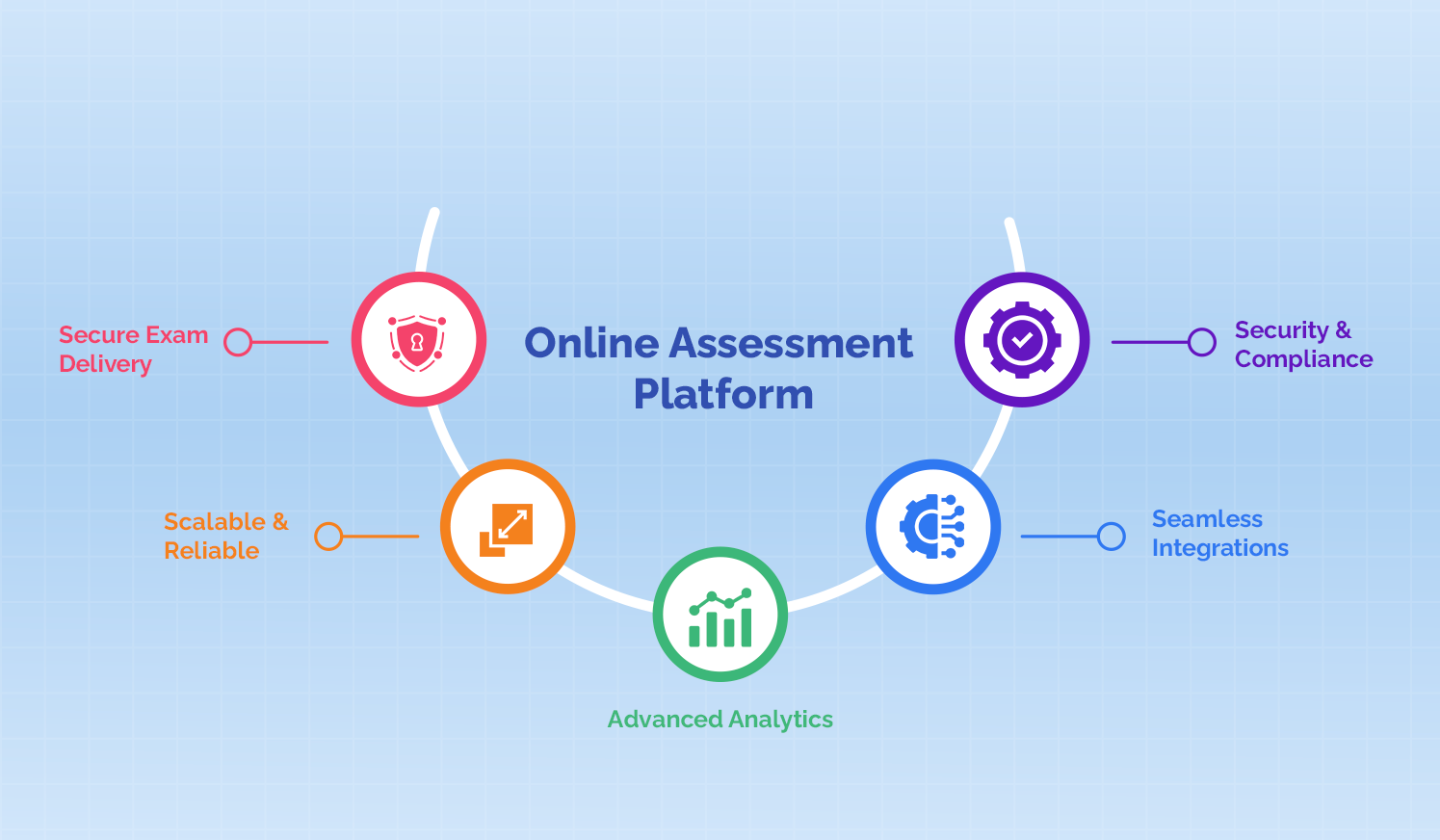
A mature digital assessment platform manages the full lifecycle of testing—from question creation to analytics – while maintaining reliability at scale.
Core capabilities
Item authoring and banks
Create reusable questions with metadata such as difficulty level, learning objective, and topic tags.
Flexible test delivery
Schedule and deliver exams across geographies with support for accommodations and large candidate volumes.
Security and proctoring
Identity verification, controlled browser environments, and monitoring help preserve exam integrity.
Automated and manual scoring
Objective grading plus workflows for human evaluation where needed.
Advanced analytics
Item performance metrics, cohort trends, and exportable reports support data-driven decisions.
Enterprise integrations
LMS, SSO, HR systems, and APIs ensure the online testing platform fits seamlessly into existing workflows.
Online Assessment vs Traditional Testing
| Feature | Traditional Testing | Online Assessment Platform |
|---|---|---|
| Scalability | Limited | Global, high-volume delivery |
| Security | Manual invigilation | AI-based proctoring & controls |
| Evaluation Speed | Slow | Instant or automated |
| Analytics | Minimal | Deep insights & reporting |
| Accessibility | Location-bound | Anywhere, anytime |
Why it matters: Organizations adopting digital assessment report faster evaluation cycles and better decision-making outcomes.
Why Online Exam Platforms Are Critical Today
Several structural shifts are accelerating adoption.
Remote and hybrid learning
Institutions must evaluate learners beyond physical classrooms and test centers. Digital delivery ensures continuity regardless of location.
Skills-based workforce transformation
Organizations increasingly prioritize demonstrated skills over credentials alone. Structured assessments provide objective validation.
AI-assisted content creation
With generative AI widely available, maintaining exam integrity requires more sophisticated monitoring and analytics capabilities.
Compliance and audit pressure
Certification bodies and universities must maintain defensible records of assessment delivery and scoring.
Organizations without modern assessment infrastructure often face slower evaluation cycles, inconsistent grading, and limited visibility into learner performance.
Essential Features of Enterprise Online Assessment Software
When evaluating vendors, decision-makers should prioritize these pillars.
1. Security and integrity
A robust solution should include:
- Identity verification
- Secure delivery controls
- Tamper-evident audit logs
- Proctoring capabilities
- Role-based access management
These features are especially critical for high-stakes testing.
2. Scalability and reliability
An enterprise online exam platform should demonstrate:
- High concurrent test delivery
- Global readiness
- Uptime commitments
- Resilience to network interruptions
Scalability directly impacts candidate experience and institutional confidence.
3. Analytics and psychometric depth
Look for platforms that provide:
- Item difficulty and discrimination metrics
- Reliability indicators
- Cohort and trend dashboards
- Exportable datasets
Strong analytics transform assessments into continuous improvement engines.
4. Integration and automation
Enterprise buyers should expect:
- LMS compatibility (LTI/SCORM)
- SSO support
- REST APIs
- HR/ATS connectivity
- Automated result workflows
Integration maturity determines long-term platform value.
5. Accessibility and compliance
Ensure the digital assessment platform supports:
- WCAG accessibility
- Accommodation controls
- Data privacy options
- Audit readiness
Accessibility is both a regulatory and learner-experience requirement.
Excelsoft’s Test & Assessment: Enterprise-Ready Approach
Excelsoft’s Test & Assessment solution is designed to support complex, large-scale programs that demand reliability, security, and deep analytics. The platform addresses the full assessment lifecycle while remaining flexible for diverse institutional and enterprise environments.
Key strengths
Unified lifecycle management
From item banking and test creation to secure delivery and reporting, the solution reduces tool fragmentation and operational overhead.
Robust exam delivery and monitoring
The system supports controlled testing environments suitable for academic and professional certification scenarios.
Advanced analytics and reporting
Detailed item analysis, cohort tracking, and performance dashboards help organizations move beyond basic scoring.
Integration-friendly architecture
The platform connects with LMS and enterprise systems using standard protocols and APIs.
Enterprise scalability
Built to support high candidate volumes and peak testing windows.
Practical Use Cases and Business Impact
Higher education and academic institutions
Use cases
- Semester exams
- Continuous assessments
- Entrance testing
Impact
- Faster grading cycles
- Improved academic integrity
- Data-driven curriculum insights
Corporate learning and talent development
Use cases
- Post-training validation
- Certification programs
- Internal mobility assessments
Impact
- Better measurement of training effectiveness
- Faster skills validation
- More objective talent decisions
Certification and licensing bodies
Use cases
- High-stakes proctored exams
- Global candidate delivery
- Compliance-driven testing
Impact
- Defensible certification programs
- Reduced fraud risk
- Stronger regulatory confidence
Best Practices for Choosing an Online Testing Platform
Before selecting a vendor:
Run a real pilot
Test with actual content and expected candidate volume.
Validate security evidence
Request compliance documentation and sample audit logs.
Examine analytics depth
Ensure psychometric outputs—not just score reports.
Test integrations early
Verify LMS, SSO, and HR connections in your environment.
Assess vendor support and SLAs
Operational maturity matters as much as features.
FAQs
What is the difference between online assessment software and a quiz tool?
Assessment software supports the full lifecycle—including item banks, secure delivery, analytics, and integrations—while quiz tools typically provide only basic functionality.
Is an online exam platform suitable for high-stakes testing?
Yes, provided it includes identity verification, secure delivery environments, monitoring, and tamper-proof audit trails.
Can a digital assessment platform evaluate coding and open-ended responses?
Modern solutions support automated scoring for objective items, sandboxed environments for coding tasks, and rubric-based human review workflows.
How do I know an online testing platform will scale?
Look for proven concurrent delivery capability, uptime commitments, and customer references running large-scale exams.
Conclusion
Assessment is no longer a back-office function—it is core infrastructure for education, certification, and workforce transformation. Organizations that invest in secure, analytics-driven online assessment platfrorm capabilities gain faster decision cycles, stronger integrity, and better learning outcomes.
Excelsoft’s Test & Assessment solution offers a balanced enterprise approach combining secure delivery, deep analytics, and integration readiness for modern assessment programs.